
Party of Three
Rev. Dr. Jeffrey Jaynes
Genesis 18:1-15 | June 14, 2026
Broad Street Presbyterian Church
Columbus, Ohio
[ Printable version ]
The number three is an interesting number. It is the first of the “odd” prime numbers and the first number that is the sum of its parts: 1+2=3. Sometimes three gets a bad rap; like in the off-putting little proverb: “two’s company, but three’s a crowd.” Ancient philosophers celebrated three as the number of harmonies, and a number that can provide balance in a world that is too often binary: I’m right, you’re wrong; I speak truth… you lie. Three suggests an alternative; a third way… in logical terms—from thesis and antithesis to synthesis.
My sermon title today is “Party of Three” – it’s what Abraham and Sarah encountered in this other-worldly visit captured for us in Genesis, chapter 18. Party of three – three men? Three angels? Three gods? Abraham reverses them and the text says with certainty, the Lord was speaking.
We’ll come back to this fascinating text in a moment, but I want to linger for a few moments on this idea of a “party of three.” I have been thinking about some groups of three that pop up rather frequently… in literature, in pop culture, and especially in music. Perhaps at the top of the list we have The Three Musketeers (les trois mousquetaires) of Alexandre Dumas, swashbuckling their way through 17th century France with its corrupt nobility. More recently, J. K. Rowling cast her own spell on the literary world of children and adolescents with the exploits of Hermoine Granger, Ron Weasly, and of course, Harry Potter. TV has had notable groups of three, dating back to the rather sophomoric “Three Stooges” or the slightly more sophisticated “Three’s Company”— perhaps an attempt to reappraise the sad legacy of “three’s a crowd.” No! Three’s company, inclusive, and rather avant-garde. And, of course, there is music; almost nothing beats a trio; fine-tuned blends of harmony and melody. I am an old timer, and for me, I am still captured by the vocal blends of the classic: “Crosby, Stills and Nash” … before they added Neil Young. I am also grateful that this past fall, Amy introduced many of us to the K-pop classic, and Netflix blockbuster: K-Pop Demon-Hunters. Rumi, Mira, and Zoey form Huntrix, this female band dedicated to fighting the demonic that steals the souls of humans. Their power—like all the girl-bands that preceded them—is in this bond of the three. But that bond is complicated, and nearly impossible to maintain.
With these various trios, these clusters of three in mind, I return to our text for today, the story of Abraham, Sarah, and their visitors.
It is a hot, sunbaked morning, nearly midday, and Abraham is already into his late morning siesta. Abraham’s tent is set up near a strand of oak trees at Mamre, and while Abraham dozes, Sarah works inside. The writer first records that the Lord, the Hebrew word for God—Adonai—appears, and as Abraham rouses, he sees three visitors. The text we read says that Abraham saw “three men”—but the word used here is an inclusive word, that could simply mean three “people,” without gender completely specified. The number three is used distinctly in the text, a couple of times, but often the three seem to speak as one. Some have speculated that the visitors were angels, messengers of the Hebrew God Yahweh. But as the conversation unfolds—with Abraham, and later with Sarah—references to the Lord, to Yahweh, continue to appear; so they were more than mere angelic messengers.
However, if one understands the identity of this divine trio, Abraham’s response is immediate and gracious. He begs the visitors to stay, he fetches water for them, he instructs Sarah to prepare bread, he selects a calf and adds it to his feast, along with cheese and milk. And perhaps like the resurrected Jesus at the sea of Tiberius with his disciples, these extra-worldly visitors actually eat and share in the meal.
Satisfied and grateful for the generous hospitality of Abraham and Sarah, one of the three speaks, and makes a promise. The promise is to return and bless Sarah with a longed-for child. Sarah overhears the conversation and cannot help but chuckle! Sorry my friend, she thinks those days are long gone. The visitor calls her out—did I hear you laugh? Oh no, she insists, not me. And here again, in the mystery of the text, it is the Lord speaking… and affirming to Sarah, and to Abraham, nothing is too wonderful, for the Lord!!
I love this beautiful passage from Genesis for several reasons: the generous hospitality of Abraham, hastening with all his preparations for these special visitors. The prominent role of Sarah, her realistic assessment of the situation, and her genuine, human response to a grandiose, divine promise. And finally, the visitors themselves, themselves, mysterious, divine, yet very real and very present. It should come as no surprise that early Christian commentators seized on this scene of three visitors, heavenly beings, yet clearly entering and intervening in this very specific, human space. Theophany is a word often used to describe this kind of encounter, a divine appearance—like God wrestling with Jacob later in Genesis; the voice speaking to Moses from a burning bush: or, the mysterious fourth person who appears with Daniel’s friends, Shadrach, Meshach, and Abednego in a Babylonian furnace. But this Genesis 18 text is unique… three visitors, who at times speak with one voice; for many this theophany, this divine appearance revealed or at least suggested, the Trinity.
Two weeks ago, we celebrated Trinity Sunday, and for many Christian traditions—we are not in the season of “ordinary time,” but in Trinity season. The “trinity”—the God who is three-in-one; it’s not an easy thing to comprehend; and an affirmation that often defies explanation. Art and image may be the best aid we have for encountering and exploring our triune God. So, for the rest of this sermon, we are going to focus on one, particular image of the Trinity that I have found powerful, effective, and affirming. It is an image, or more properly, an icon that may be familiar to many of you, and it is based in the story we have been discussing. It is the image/ icon of the Holy Trinity, created by the Russian iconographer Andre Rublev; some of you may have seen the copy of this icon that hangs in Pastor Ann’s office.
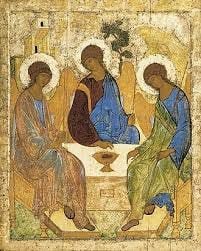
In the year 2000, I was in Moscow and had the opportunity to see Rublev’s original, 15th century version of this icon, displayed in the Tretyakov gallery. Even better was the day trip I made to the original setting for the icon—the monastery of St. Sergius, about a two-hour trek from Moscow on a freezing cold March morning. I was teaching a short course at a Methodist seminary in Moscow, and my guide and traveling companion for my daytrip was Prof. Andrei Kim. He insisted we stop for lunch at… McDonalds… across the street from this centuries’ old monastery. It was surreal, having a Big Mac directly across from the entry gate of Sergius’s monastery dedicated to the Holy Trinity.
I knew the icon principally because of this book by the great Roman Catholic spiritual and mystical writer: Henri Nouwen. I am going to draw on Nouwen’s book, Behold the Beauty of the Lord, Praying with Icons, as we reflect for just a few moments on this powerful image… Nouwen writes, “The spiritual life keeps us aware that our true house is not the house of fear, in which the powers of hatred and violence rule, but the house of love, where God resides”
He continues: “I have never seen the house of love more beautifully expressed than in the icon of the Holy Trinity painted by Andrew Rublev in 1425 in memory of the great Russian saint, Sergius (1313-1392). For me, the contemplation of this icon has increasingly become a way to enter more deeply into the mystery of divine life while remaining fully engaged in the struggles of our hate-and-fear filled world… As we place ourselves in front of the icon in prayer, we come to experience a gentle invitation to participate in the intimate conversation that is taking place among the three divine angels and to join them around the table. The movement from the Father [left] toward the Son [center above chalice] and the movement of both Son and Spirit [right] toward the Father become a movement in which the one who prays is lifted up and held secure… Through the contemplation of this icon we come to see with our inner eyes that all engagements in this world can bear fruit only when they take place within this divine circle… From within this holy circle, this house of love, the mystery of God is revealed to us.” [Nowen, Behold the Beauty of the Lord: Praying with Icons, 2007, pp. 31-34.]
And I want to add one final observation, that I find notable and intriguing… and important during this Pride month. Look again at the icon… Gender is not distinguishable in these figures; the male-female binary disappears. Certainly, the image of God, the Imago Dei, as we know from Genesis One, is expressed in the creation of man and woman, male and female… but not exhausted! Somehow, in the very heart, the essence of our God, is this complicated, yet compelling presence of the three—gathered around a table. Here, in this image, the magnificence, the majesty, the mystery of the divine is not expressed in two, but in three.
So… party of Three, holy and unfathomable Trinity, your table is ready! Amen.
